

How therapeutic horticulture for rehabilitation supports functional goals and where to find the evidence to guide your work.
Rehabilitation professionals across disciplines are seeing growing interest in nature-based interventions. Whether integrated into physical therapy, occupational therapy, recreational therapy, or community rehabilitation programs, plant- and nature-based approaches can offer an accessible way to support functional improvements, emotional regulation, engagement, and quality of life.
At the same time, many therapists share a common challenge: even though the benefits of engaging with plants and natural environments are increasingly recognized, finding high-quality research to guide practice can be time-consuming and fragmented.
This post is part of our Root in Nature series exploring how therapeutic horticulture fits into different allied health professions. Here, we’re focusing on rehabilitation practice, and one practical tool that can support evidence-informed care: Root in Nature’s free, open-access Research & Readings Database, created in collaboration with Dr. Diane Relf.
Table of Contents

What Therapeutic Horticulture Brings to Rehabilitation Practice
Therapeutic horticulture and other nature-based interventions can support a wide range of rehab goals. In clinical and community-based settings, garden and plant-based activities are already being used to support:
- Upper-body strength and fine-motor coordination
- Cognitive engagement, attention, and memory
- Emotional regulation and stress reduction
- Sensory stimulation
- Social participation and group cohesion
- Vocational and independent living skill development
- Motivation, agency, and meaningful occupation
This is one of the reasons therapeutic horticulture can fit so naturally within rehabilitation: it offers purposeful, real-world activities that can be scaled, adapted, and aligned with functional outcomes, while also supporting emotional and social well-being.
| Rehabilitation Goal | Gardening Activities That Support It |
|---|---|
|
Upper-body strength |
Digging, watering, planting in raised beds |
|
Fine-motor coordination |
Sowing seeds, pruning, potting plants |
|
Fine-motor coordination |
Planning layouts, labeling, sequencing tasks |
|
Emotional regulation |
Sensory gardening, mindfulness tasks |
|
Sensory stimulation |
Sensory stimulation |
|
Social participation |
Group gardening, harvest sharing |
|
Vocational/ADL skills |
Routine care, tool use, following schedules |
|
Purpose & motivation |
Nurturing plant growth, visible progress |
Why a Centralized Resource Matters in Rehabilitation
The challenge rehabilitation professionals often face isn’t a lack of evidence.
Research exploring horticultural therapy, therapeutic horticulture, and nature-based health interventions has expanded rapidly in recent years. The issue is that the research is spread across many disciplines—such as rehabilitation sciences, psychology, nursing, public health, occupational science, environmental health, and gerontology.
Without a centralized source, therapists may spend hours searching for articles, sorting through unrelated results, or relying on informal summaries rather than direct evidence.
In conversations with practitioners, a few patterns come up again and again:
| Barrier | What It Looks Like |
|---|---|
|
Evidence is scattered across disciplines |
A therapist searching for research on gardening and stroke rehabilitation, for example, may need to look across occupational therapy databases, gerontology journals, public health publications, and environmental psychology research. |
|
Limited time to search |
Rehabilitation settings are busy. Many therapists are gathering evidence on top of full clinical caseloads, with limited access to research support. |
|
Terminology is inconsistent |
Nature-based interventions may be described using many different terms—horticultural therapy, therapeutic horticulture, green care, social and therapeutic gardening, ecotherapy, and nature-assisted therapy—making keyword searches inconsistent and frustrating. |
|
Program evaluation expectations are increasing
|
Therapists are increasingly expected to justify program value, demonstrate outcomes, and contribute to quality improvement initiatives. Quick access to peer-reviewed evidence supports stronger documentation, proposals, and reporting. |
Root in Nature’s Research & Readings Database: What It Offers
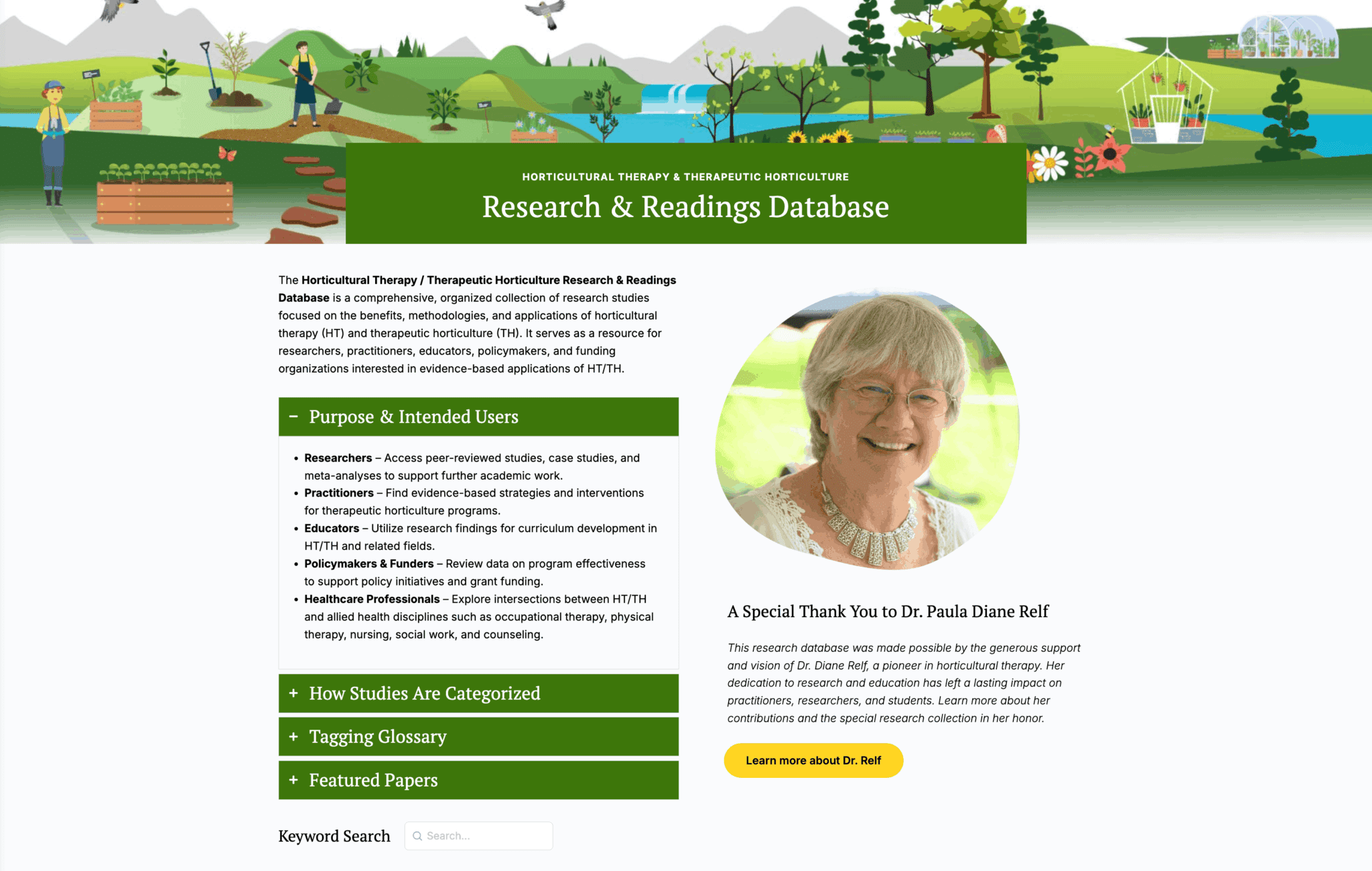
To support this need, Root in Nature, working in collaboration with Dr. Diane Relf, developed a free, open-access Research & Readings Database that organizes more than 750 peer-reviewed articles and selected publications related to therapeutic horticulture, horticultural therapy, and other nature-based health interventions.
This database was designed with practitioners in mind. The goal is simple: make it easier for professionals to locate credible evidence, apply it to clinical reasoning, and strengthen the alignment between nature-based and allied health interventions and therapeutic goals.
Dr. Relf is Professor Emerita at Virginia Tech is an internationally recognized pioneer in horticultural therapy, and the founding chair of the International People Plant Council. Her leadership and deep expertise in evidence-informed practice helped shape the structure, quality, and professional relevance of the database.
Searchable tags that support clinical reasoning
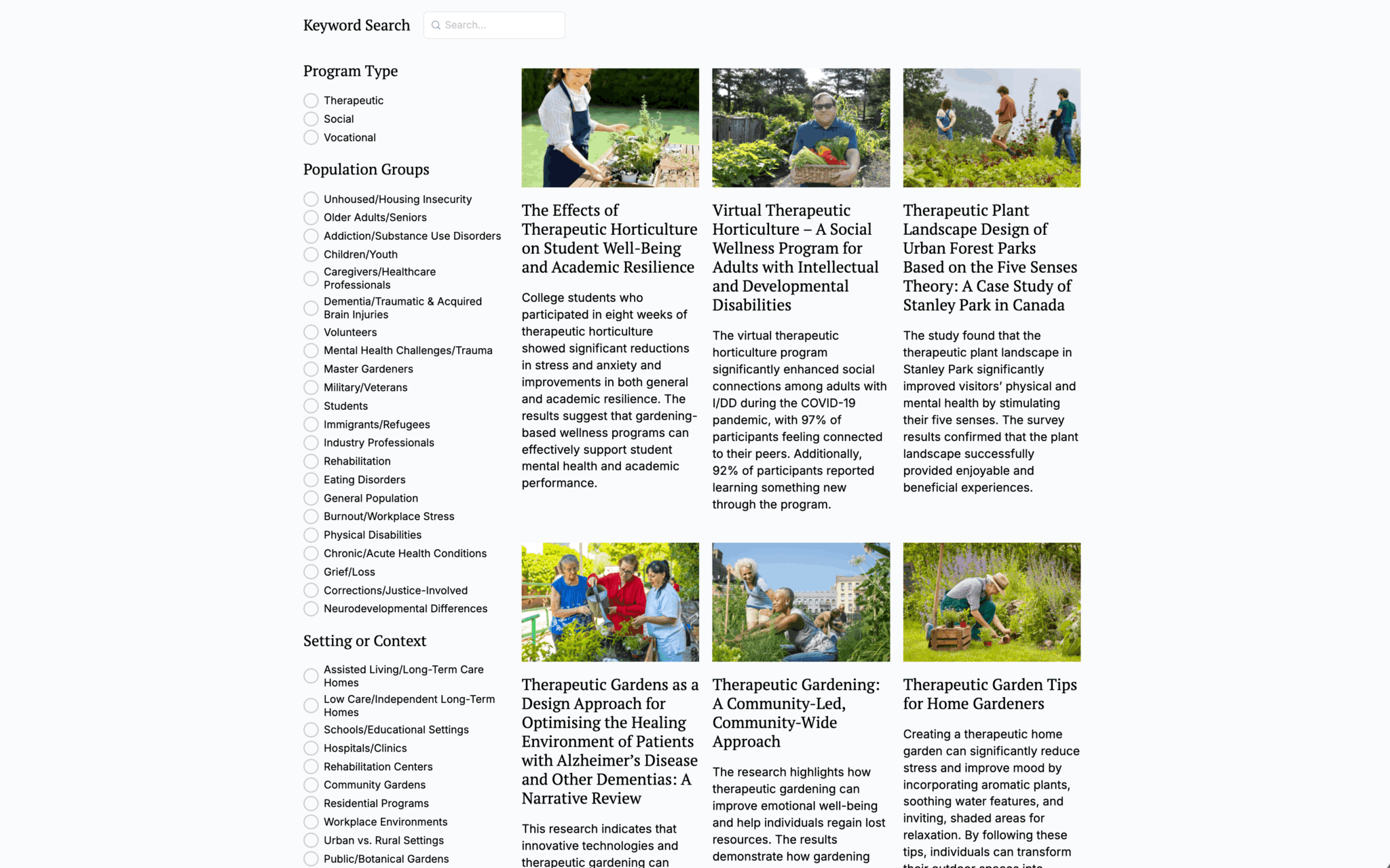
Each article is tagged using a structured system that includes:
- Population Groups
- Setting or Context
- Health & Wellness Outcomes
- Type of Activity
- Allied Profession Intersections
These tags allow rehabilitation professionals to filter quickly and find research aligned with priorities like emotional well-being, cognitive stimulation, physical activation, sensory engagement, social connection, and participation outcomes.
After selecting criteria, the database shows how many publications match that search, and users can view individual studies or download a complete list of those articles (including links) for easy reference and sharing.
Short and extended summaries for each article
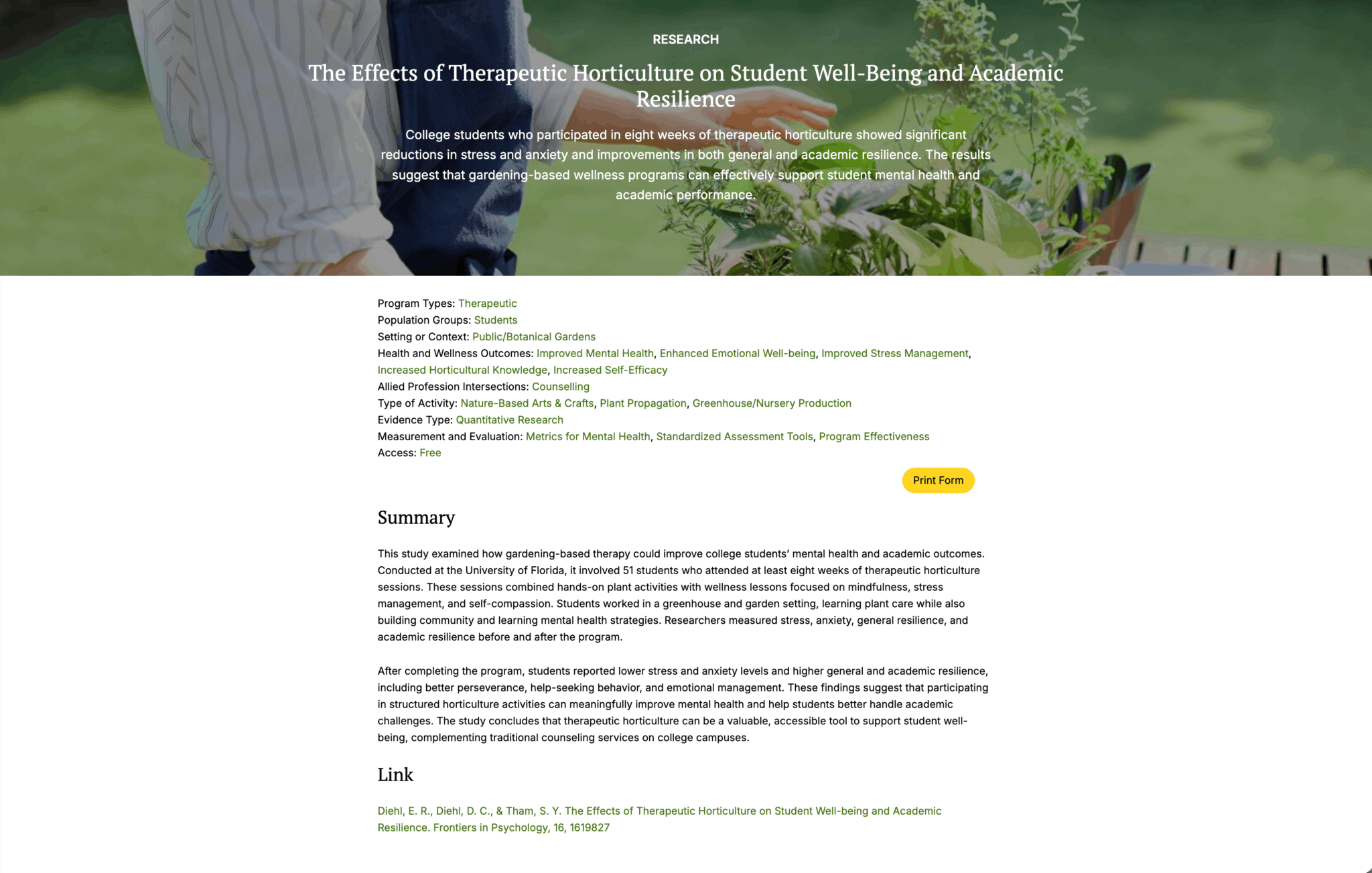
Each entry includes a concise summary for quick review and a longer summary for deeper understanding. This helps clinicians understand core findings, methods, and implications without immediately needing to track down the full text.
APA citations for simple reference
A complete APA citation is included that can be used in:
- clinical documentation
- program proposals
- grant applications
- presentations
- educational materials
Direct links to original publications
A link to the original source is always included. In many cases, full-text papers are freely available; in others, access may depend on institutional subscriptions. The database includes an “Access” tag so users can filter for open-access studies when needed.
Practice-informed publications beyond academic journals
In addition to journal articles, the database includes selected practice-informed publications—such as reports, case studies, and evaluations—to support application in clinical and community contexts.
And importantly: this is a living resource. New research is added regularly, and feedback from practitioners and organizations helps keep it relevant and representative of diverse professional, therapeutic and cultural contexts.
How Rehabilitation Professionals Can Use the Database
The structure of the database is designed to support the day-to-day tasks rehabilitation professionals already do, especially when time is limited.
1) Treatment planning and intervention design
Therapists often rely on research to select interventions that support functional goals. For example:
- An OT working on fine-motor coordination can search for evidence on plant-based activities that involve grasp-and-release movements, bilateral coordination, or sustained hand strength.
- A PT exploring outdoor mobility programs can search for studies linking garden engagement with gait speed, balance, or endurance.
- A recreational therapist supporting emotional well-being can search for research on stress reduction, engagement, and social connection through gardening activities.
Instead of spending hours searching across different databases, therapists can quickly identify research aligned with their priorities.
2) Strengthening clinical documentation
Evidence-informed documentation is increasingly valuable across rehabilitation settings. Therapists can use the database to:
- support rationale for interventions in initial assessments
- cite evidence in progress notes
- strengthen discharge summaries
- justify the clinical relevance of horticulture-based activities
Being able to reference peer-reviewed research also supports interdisciplinary communication and helps clarify the therapeutic intent behind plant-based interventions.
3) Supporting program proposals and funding applications
Whether you’re developing a new sensory garden, expanding outdoor programming, or requesting equipment, proposals are stronger when grounded in evidence.
The database includes research that links nature-based interventions with outcomes such as:
- reduced agitation in dementia care
- improvements in mood and engagement
- physical, cognitive, and psychosocial benefits across populations
This can strengthen budget requests and help administrators and funders understand the clinical value of nature-based programming.
4) Enhancing staff training and student education
If you support learners or staff development, the database can be used to:
- assign readings to students
- support journal clubs or in-service presentations
- integrate evidence into student competencies
- strengthen understanding of therapeutic rationale
Because the database is open-access, it can be shared easily with interns, practicum students, and new staff.
5) Guiding evaluation and quality improvement
Rehabilitation teams conducting evaluation or QI initiatives can use the database to identify outcome measures, locate similar program models, and benchmark against published findings. The structured summaries also support teams in understanding study design, limitations, and clinical relevance.
How Researchers Can Use the Database
While this resource was designed with practitioners in mind, it also supports researchers across rehabilitation, public health, and environmental health fields.
Researchers can use the database to:
- locate comparable intervention models
- explore populations or therapeutic goals not yet well-represented
- discover cross-disciplinary studies relevant to rehabilitation research
- build focused literature reviews efficiently using the tagging system
Because it includes both academic research and select practice-informed publications, it can support mixed-methods, community-engaged, and translational work.
A Collaborative Effort and an Invitation to Contribute
One of the goals behind the Research & Readings Database is to support a field where terminology, program models, and therapeutic applications vary widely.
By centralizing research and making it accessible, this resource helps rehabilitation professionals:
- see the breadth of evidence across settings and populations
- identify emerging trends
- strengthen the integration of nature-based interventions into clinical care
As the database grows, contributions from rehabilitation professionals, researchers, and organizations play an important role in ensuring it reflects diverse therapeutic, cultural, and population and setting-specific contexts.
Program evaluations, clinical reports, case studies, and international research are welcomed for consideration.
Submissions can be emailed to: research@rootinnature.ca
Accessing the Research & Readings Database
The Research & Readings Database is free and open to all practitioners, researchers, and students.
Why This Matters for Rehabilitation Practice
Rehabilitation therapists play a vital role in helping people regain function, restore confidence, and re-engage in meaningful activities. Nature-based interventions are one of many tools available, and when they’re grounded in evidence, they can complement and strengthen traditional rehabilitation approaches.
By bringing together hundreds of studies in one accessible, organized place, Root in Nature’s Research & Readings Database makes it easier to find relevant research, apply it to clinical reasoning, and clearly communicate the therapeutic intent behind plant- and nature-based interventions.
As interest in integrating nature into rehabilitation continues to grow, easy access to high-quality evidence will remain essential. This database offers a practical, clinician-friendly way to support evidence-informed care and advance patient-centered practice.
Frequently Asked Questions
What is therapeutic horticulture in rehabilitation?
Therapeutic horticulture is the intentional use of plant and nature-based activities to support rehabilitation goals such as physical function, cognitive engagement, emotional regulation, and social participation. In rehabilitation settings, it complements traditional therapies by providing meaningful, real-world activities aligned with functional outcomes.
How can therapeutic horticulture support rehabilitation goals?
Therapeutic horticulture can support rehabilitation by addressing physical, cognitive, emotional, and social goals simultaneously. Research shows plant-based activities can improve fine-motor skills, upper-body strength, attention, memory, mood regulation, sensory processing, motivation, and participation in meaningful occupations.
Is there evidence supporting therapeutic horticulture in rehabilitation?
Yes. A growing body of peer-reviewed research supports the use of therapeutic horticulture and nature-based interventions across rehabilitation, public health, gerontology, psychology, and occupational science. The challenge is not a lack of evidence, but that the research is spread across many disciplines.
What is the Research & Readings Database from Root in Nature?
The Research & Readings Database is a free, open-access resource that organizes more than 750 peer-reviewed articles and practice-informed publications related to therapeutic horticulture and nature-based health interventions. It was created to help professionals quickly locate credible evidence and apply it to clinical practice.
How can rehabilitation professionals use the database in day-to-day practice?
Rehabilitation professionals can use the database to support treatment planning, strengthen clinical documentation, justify interventions, inform program proposals, guide evaluation and quality improvement, and support staff or student education with credible evidence.
Who developed the Research & Readings Database?
The database was developed by Root in Nature in collaboration with Dr. Diane Relf, Professor Emerita at Virginia Tech and an internationally recognized leader in horticultural therapy and evidence-informed practice.